GoCardless says it helps businesses collect and send payments, minimise failures and fight fraud. Its Direct Debit guide describes Direct Debit as an automated payment method that lets a merchant pull payment directly from a customer’s bank account. That is a strong fit when your clients agree to be debited on a schedule.
Recurring B2B payments have more than one side, though. Some clients would rather push a bank transfer to your account each month. Some pay in stablecoins. And the money you collect still has to reach suppliers abroad. This guide compares Bancoli, Stripe Billing, Wise Business and Airwallex against that wider job.
In short
- Keep GoCardless when your clients agree to Direct Debit and pulling payments on a schedule is the main job.
- Look at Bancoli when clients pay you on named USD details or in stablecoins and you pay suppliers in local currency from a self-custodial Smart USD Wallet.
- Look at Stripe Billing when you need recurring and usage based pricing tied to how customers pay you online.
- Look at Wise Business and Airwallex when international bank transfers or a wider finance platform are the main need.
Why this matters
A recurring payment is a cycle, not one event. You agree terms with the client, you send an invoice or a reminder, the client pays, you match the money to the invoice, and then you pay your own suppliers.
Direct Debit solves one part of that cycle: how the money is collected. It does not decide how you hold the money, who can approve a payment out of it, or how a supplier in another country gets paid. Start your shortlist with the part of the cycle that is causing trouble.
Ask four plain questions. How do your clients want to pay? Do you control the funds once they arrive? Can you pay your suppliers in the currency they use? Can your accountant match every payment to an invoice?
GoCardless alternatives at a glance in 2027
| Option | Good fit for | What to look at | Difference from GoCardless |
|---|---|---|---|
| GoCardless | Businesses whose clients agree to Direct Debit | Pulling payments from client bank accounts on a schedule | The benchmark for bank debit collection |
| Bancoli | Businesses already using stablecoins | Named USD account details, a self-custodial Smart USD Wallet and free FX in 25+ currencies on local payouts | Clients pay your named USD details or send stablecoins, and you pay suppliers from the same wallet |
| Stripe Billing | Businesses selling subscriptions online | Recurring and usage based pricing set up by API or in a dashboard | Built around online subscription billing |
| Wise Business | Businesses focused on international bank transfers | Paying and getting paid in other currencies | Compare it on cross-border money movement |
| Airwallex | Businesses looking at a wider finance platform | Business accounts, transfers, payments and billing | Compare its billing and payments setup against your cycle |
“Good fit for” describes the job each option is built around. It is not an overall ranking. Your business location, your clients’ payment habits and your suppliers’ countries decide which options stay on your list.
1. Bancoli: for businesses already paid in stablecoins
Bancoli is a stablecoin on-ramp and off-ramp for businesses. It is not an account that holds many local currencies. Your Smart USD Wallet holds supported stablecoins, and you convert when you pay out.
The Smart USD Wallet can accept and hold USDC, USDi and USDT (USDT on Ethereum only, when your account shows it). The wallet is self-custodial. You control your funds. Bancoli does not own or control them. Banking services are provided through an affiliated chartered bank.
Named USD account details in your business’s legal name are available on every plan, including Free, once your business is verified. Bancoli receives US dollars by ACH, RTP, US domestic wire and stablecoins, and sends by ACH, RTP and local payouts. ACH and RTP payments arrive as supported stablecoins in your Smart USD Wallet, and they convert 1:1. You pick the supported stablecoin. You can also buy USDC with USD by sending it by ACH or RTP from your own business bank account to your named USD details and choosing USDC. Receiving an ACH or RTP payment costs $2 on Free, $1 on Plus, and it is free on Premium.
To pay a supplier, you choose a supported currency and route for their location and pay from your Smart USD Wallet. Your supplier receives local currency in their own bank account. They do not need a Bancoli account for a supported bank payout. You get free FX in 25+ currencies on local payouts, and the pricing page lists the currencies. You can see the steps on Bancoli global payouts.
Every plan also includes invoicing, so you can create, send and track invoices to your clients.
Where Bancoli fits
- Clients pay your named USD details by ACH or RTP each cycle, or send stablecoins, and you pay suppliers from the same Smart USD Wallet.
- Every plan can create, send and track invoices to your clients, so each payment has an invoice to match.
- Suppliers abroad keep the bank account they already use, and you get free FX in 25+ currencies on local payouts.
- The wallet is self-custodial. You control your funds.
Where to check before you switch
- With named USD details, your clients send each payment to you, or send stablecoins. If your process depends on pulling money from client accounts under a mandate, confirm how that would work before you move it.
- A supported currency does not mean every supplier or payment qualifies. Availability, routes and fees depend on your business, your supplier and the payment route.
- Businesses from 150+ countries are eligible. Access still depends on your business, your location and verification. Check eligibility before you apply.
- Decide who on your team can approve payments from the wallet, and write it down.
| Dimension | Bancoli | GoCardless benchmark |
|---|---|---|
| How clients pay | Named USD details by ACH, RTP and US domestic wire, plus stablecoins | You pull payment from their bank account by Direct Debit |
| Who controls the funds | You do. The wallet is self-custodial | Ask how funds move for your account |
| ACH and RTP | No Bancoli limit on ACH or RTP | Check the terms that apply to your account |
| Paying suppliers abroad | Local payouts, with free FX in 25+ currencies on local payouts | Confirm the currency and route you need |
| Test before you switch | Run one billing cycle and one supplier payment end to end | Keep the clients who rely on Direct Debit on it |
Good fit for: businesses and solopreneurs already using stablecoins that bill clients on a cycle and pay suppliers abroad.
Our take: worth a trial for clients who already push payments to you, once your eligibility is confirmed. Keep Direct Debit for the clients who depend on it.
2. Stripe Billing: for online subscription pricing
Stripe says Stripe Billing lets you set up recurring and usage based pricing with APIs or within its Dashboard. It belongs on your list when your recurring revenue is a subscription that customers sign up for online.
Compare it on the billing model you sell, not on how you pay suppliers. A subscription tool answers how you charge. It does not answer how you hold stablecoins or pay a supplier in another country.
Where Stripe Billing fits
- Recurring and usage based pricing matches businesses that sell plans or metered services online.
- It is a useful benchmark when your clients pay through a sign up flow rather than by bank transfer against an invoice.
Where to check before you switch
- Choosing a subscription tool does not settle how your business handles the stablecoins it already holds.
- You still need to confirm approvals, accounting and how you pay suppliers abroad.
These are limits of the comparison, not claims that a feature is missing. Ask for current product documentation or a demo before you decide.
Good fit for: businesses that sell subscriptions or metered plans online.
Our take: worth a trial if online subscription pricing is the gap. Wait if B2B invoicing and supplier payments are the open questions.
3. Wise Business: for international bank transfers
Wise describes Wise Business as an international business account for doing business in other currencies, where you can pay invoices, get paid and manage expenses. It belongs on your list when international transfers and currency conversion are the main problem in your cycle.
Start with the payment you need to receive or send. Compare the business eligibility, the way your clients would pay you and the route to your suppliers.
Where Wise Business fits
- Its focus on international transfers and currency conversion matches a review led by bank transfers.
- It is a useful benchmark when your clients and suppliers both want bank transfers rather than stablecoins.
Where to check before you switch
- A transfer service does not answer how your business will handle the stablecoins it already holds.
- Confirm how recurring client payments would be requested and matched.
| Dimension | Wise Business | GoCardless benchmark |
|---|---|---|
| Main question | Does it cover your international transfer routes? | Does it cover how you collect from clients? |
| Cost check | Compare the rate and delivery terms you can actually get | Compare the full collection cost you pay now |
| Test before you switch | Check the accounting handoff and the approvals you need | Keep Direct Debit where clients rely on it |
Good fit for: businesses whose first need is international bank transfers and currency conversion.
Our take: worth a trial once your routes and controls pass your comparison.
4. Airwallex: for a wider finance platform
Airwallex describes itself as a financial platform that brings together business accounts, transfers, expenses, payments and billing. It is a candidate when you want to review billing, payments and accounts with one provider.
Check it against the countries, currencies and workflows your business really uses. A broad platform still has to meet your own receiving, approval and record keeping needs.
Where Airwallex fits
- Its billing and payments focus makes it relevant when you want to compare more than one part of the cycle at a time.
- It gives you one more platform to compare on collection, conversion and supplier payments together.
Where to check before you switch
- A broad product list does not confirm support for your business or your supplier’s country.
- A list of payment products does not tell you whether it offers a self-custodial stablecoin wallet.
Good fit for: businesses comparing one wider finance platform against separate tools for billing and supplier payments.
Our take: wait until your business, countries and controls are confirmed in a demo.
Why businesses look past GoCardless
Businesses look at other options when their clients stop fitting the Direct Debit model. That is not a complaint about Direct Debit. It is a sign that collection is only one part of the cycle.
These needs are worth a look at other options:
- Clients abroad would rather send a bank transfer to named USD details than sign a debit mandate.
- Some clients want to pay in stablecoins.
- Your business holds stablecoins and needs to know who controls them.
- Suppliers send invoices in their local currency and name the bank account to pay.
None of these means GoCardless has to go. You can keep Direct Debit for the clients who use it and move other clients and supplier payments to another service.
Run one billing cycle before you switch
Test a full cycle with one real client and one real supplier before you move everyone. It shows the gaps before a missed payment becomes the test.
Agree how each client pays
Write down, for each client, how they pay, the currency, the invoice reference they will use and the date the payment is due. A client paying by ACH needs your named USD details. A client paying in stablecoins needs the stablecoin and the supported network agreed in writing.
Match each payment to an invoice
Send the invoice, wait for the payment and match it. The guide on matching stablecoin receipts to invoices walks through the references to keep.
Pay a supplier from the funds
Pay one supplier in their local currency and confirm the amount they received. Check every charge on the route before you approve it. A headline FX claim does not replace the actual payment terms.
Close the cycle in your records
Match the invoice to the money received, any conversion and the supplier payout. Keep bank payment references and blockchain transaction IDs apart, so your accountant knows what each record proves.
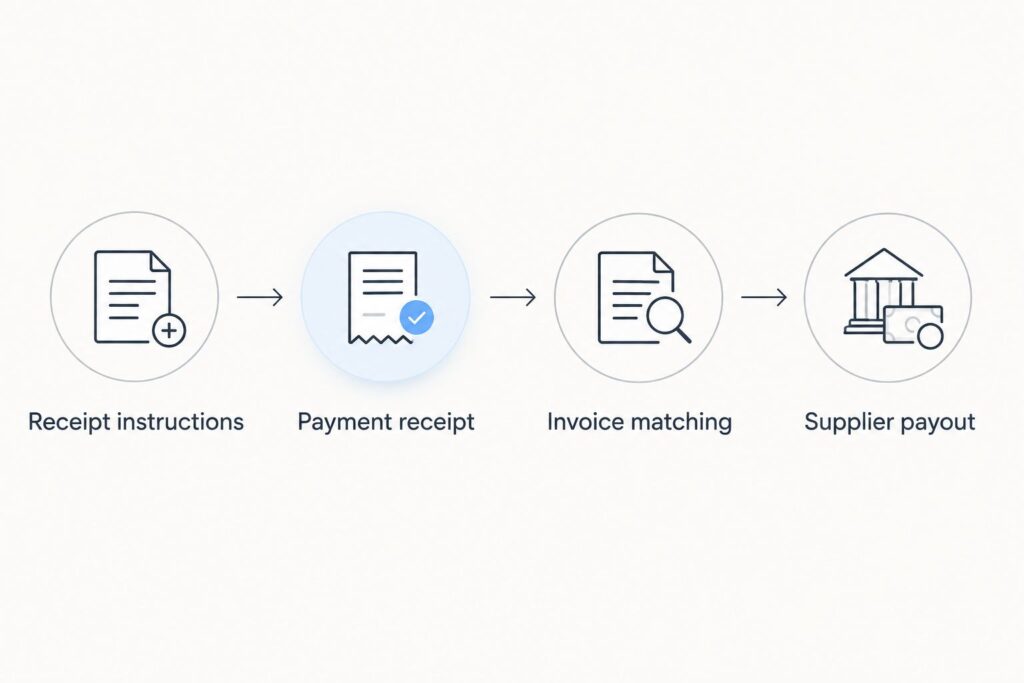
A payment that arrives does not prove the supplier payout will work. Decide which event closes each invoice, and keep the evidence for it.
When staying with GoCardless is the right call
Stay with GoCardless when your clients are happy to be debited and collection is the problem you are solving. Moving clients off a working Direct Debit setup is a separate project, and it does not fix supplier payments by itself.
Using two providers can make sense. Keep Direct Debit for the clients who rely on it, then review USD receiving details, stablecoins and supplier payouts on their own terms.
FAQ
What is a good GoCardless alternative for international B2B clients in 2027?
Bancoli fits businesses that already use stablecoins and want clients to pay named USD account details or send stablecoins, then pay suppliers in local currency from a self-custodial Smart USD Wallet. Confirm your eligibility, verification and supplier countries before you choose it.
Do I have to stop using Direct Debit to use stablecoins?
No. You can keep Direct Debit for the clients who use it and review how other clients pay you, and how you pay suppliers, as a separate decision.
Can clients pay a recurring invoice by ACH or RTP to Bancoli?
Yes. Clients can send ACH or RTP payments to your named USD details, and they arrive as supported stablecoins in your Smart USD Wallet. Receiving an ACH or RTP payment costs $2 on Free, $1 on Plus, and it is free on Premium.
Should I compare Stripe Billing with GoCardless?
Yes, when online subscription pricing is the need. Compare it on the billing model you sell, separately from how you pay suppliers.
Does a supported currency mean my supplier can receive a payout?
Not on its own. Check the supplier’s country, bank details, the payment route and your own verification before you send. Availability and fees depend on your business, your supplier and the payment route.
One last thing
Plan for the payment that does not arrive, not only the one that does. Before you switch, decide who chases a late client, what reference identifies each payment and what your finance team needs to trace it.
If you want clients to pay you in USD and to pay suppliers in their own currency from one wallet, start with the Smart USD Wallet and check the fees on pricing.