Invoice payment processing costs businesses more in delayed cash flow than most finance teams realize. Professional services firms average 45-60 days sales outstanding (DSO), while manufacturing companies frequently exceed 50 days. Consequently, working capital stays trapped in unpaid invoices instead of funding growth, payroll, and supplier commitments.
The root cause is not slow-paying clients. In most cases, the friction comes from offering limited payment options on invoices. When a buyer receives an invoice with only one payment method, they must adapt to your preferred rail, which delays action. Embedded invoice checkout reduces this dependency by putting payment options directly into each invoice.
This guide compares invoice payment processing platforms, explains how embedded checkout and early payment discounts can reduce DSO, and identifies which solution delivers the fastest path to cash flow optimization.
Key takeaways
- B2B invoice payment processing averages 30-60 days DSO depending on industry, trapping working capital in unpaid invoices
- On paid plans, Instant Checkout accepts ACH debit and Bancoli debit. This reduces payment friction.
- Early payment discounts of 2% for 10-day payment on net-30 terms deliver an annualized return of about 37% for the buyer
- Platforms like Stripe, QuickBooks, and Bill.com support card and ACH payments but lack cash flow acceleration tools like Guaranteed Invoices
- On paid plans, Bancoli also offers AI-suggested early discounts and Guaranteed Invoices to help reduce DSO.
Why traditional invoice payment processing creates cash flow problems
Finance teams typically send invoices with a single payment method attached: a bank transfer instruction, a card payment link, or an ACH authorization form. This single-rail approach creates three compounding problems.
Single-rail dependency limits buyer flexibility
When an invoice offers only wire transfer instructions, a client who prefers ACH or stablecoin payments must contact your team to arrange an alternative. As a result, this back-and-forth communication delays payment by 5-15 days on average. The problem compounds with international clients who may not have access to your preferred payment rail at all.
Fragmented systems increase reconciliation errors
Many businesses accept payments through multiple processors but manage each rail separately. Specifically, one portal handles ACH, another tracks wire confirmations, and a third monitors card payments. This fragmentation forces finance teams to check multiple dashboards daily, increasing reconciliation errors and complicating cash flow forecasting.
In fact, companies using fragmented invoice processing systems spend an estimated 5-10 hours per month per team member on manual reconciliation tasks. Consolidating all payment rails into a single platform eliminates this overhead entirely.
Industry DSO benchmarks reveal the cash flow gap
Days Sales Outstanding varies significantly by sector. However, most B2B companies operate well above optimal levels:
- Retail and e-commerce: 5-20 days DSO
- Wholesale distribution: 30-50 days DSO
- Professional services (consulting, legal, accounting): 40-60 days DSO
- Manufacturing: 45-60 days DSO
- Healthcare: 45-70 days DSO
- Construction and general contracting: 60-90+ days DSO

As a hypothetical example, a professional services firm billing US$500,000 monthly with 50-day DSO has approximately US$833,000 locked in outstanding invoices at any given time. In this illustration, every 10 days of DSO reduction would free about US$167,000 in working capital.
| Industry | Average DSO | Target DSO | Working capital trapped (US$500K/mo revenue) |
|---|---|---|---|
| Retail / E-commerce | 5-20 days | 5-10 days | US$83K-US$333K |
| Wholesale Distribution | 30-50 days | 20-35 days | US$500K-US$833K |
| Professional Services | 40-60 days | 25-40 days | US$667K-US$1M |
| Manufacturing | 45-60 days | 30-45 days | US$750K-US$1M |
| Healthcare | 45-70 days | 30-50 days | US$750K-US$1.17M |
| Construction | 60-90+ days | 45-60 days | US$1M-US$1.5M+ |
What embedded invoice checkout means
Embedded invoice checkout puts payment options directly into each invoice. Instead of sending payment instructions separately, your client opens the invoice and pays from it. On paid plans, Instant Checkout accepts ACH debit and Bancoli debit.
How this differs from traditional payment processing
Traditional invoice payment processing requires either a single embedded payment link (typically card or ACH) or separate payment instructions sent alongside the invoice. Beyond Instant Checkout, Bancoli also lets you receive by ACH, RTP, US domestic wire and stablecoins on your named USD account details:
- ACH transfers: Cost-efficient, with no Bancoli limit and 1-3 day settlement
- Wire transfers (US domestic): Designed for high-value USD amounts with full audit trails
- Stablecoin payments: Settlement time depends on the network
- Network payments: Payments between Bancoli accounts, included on every plan
Your client pays the way that fits their banking setup, transaction size, and timing needs. This reduces payment friction and can help reduce DSO.
| Payment Rail | Optimal Transaction Type | Settlement Time | Cost on Bancoli |
|---|---|---|---|
| ACH Transfers | Domestic US transactions, recurring invoices | 1-3 business days | ACH debit via Instant Checkout on paid plans |
| Wire Transfers (SWIFT) | International high-value transactions above US$50,000 requiring full audit trails | 1-5 business days | Not encouraged at Bancoli |
| Stablecoin Payments | Any amount, urgent payments, weekend or after-hours settlement, cross-border without FX delay | Depends on the network | Clients can pay you in stablecoins |
| Bancoli Network | Payments between Bancoli accounts, supply chain partners on the same platform | Depends on the network | Between Bancoli accounts |
Invoice payment processing platforms compared
Several platforms handle invoice payment processing, but they differ significantly in payment rail support, pricing structure, and cash flow acceleration features. Consequently, choosing the right platform depends on your transaction volume, international needs, and working capital priorities.

Stripe Invoicing
This platform specializes in developer-friendly payment infrastructure with invoicing as an add-on feature. Stripe Invoicing charges 0.4-0.5% per paid invoice on top of standard payment processing fees (2.9% + US$0.30 for cards, 0.8% for ACH capped at US$5). Invoices support 25+ languages and 135+ currencies.
Stripe excels at card-based payment acceptance and provides strong API customization. However, Stripe does not offer cash flow acceleration tools like early payment discounts and guaranteed invoices. For businesses prioritizing card acceptance and developer flexibility, Stripe Invoicing performs well. For B2B invoice processing with cash flow optimization, significant gaps remain.
QuickBooks Payments
This platform integrates payment processing directly into QuickBooks accounting software. Transaction fees include 2.99% for card payments and 1% for ACH transfers. QuickBooks accepts cards, ACH, PayPal, Venmo, and Apple Pay.
The primary advantage is seamless accounting integration. Essentially, payments automatically match to invoices and update your books. QuickBooks supports automatic payment reminders and recurring invoices. On the other hand, the platform does not support wire transfers or stablecoins. Cash flow acceleration is limited to basic payment reminders without early discount automation or guaranteed invoice mechanics.
Bill.com (BILL)
This platform focuses on accounts payable and accounts receivable automation. Plans start from US$49 per user per month, with card payments at 2.9%. The platform integrates with QuickBooks, Xero, and NetSuite.
Bill.com provides strong AP/AR workflow automation including invoice approval routing, scheduled payments, and vendor management. By contrast, it does not support stablecoin payments or AI-suggested early payment discount terms. For accounts payable automation, Bill.com is a strong choice. For receivables optimization, the feature set falls short.
FreshBooks
This platform targets freelancers and service-based small businesses with user-friendly invoicing. Plans start from US$23 per month, with card payments at 2.9% + US$0.30 and ACH bank transfers at 1%, with caps on Select plans.
FreshBooks provides clean invoice templates, time tracking, and basic expense management. Similarly, the platform supports payment schedules for installments and recurring billing. However, FreshBooks does not offer wire transfer acceptance or stablecoin rails. For freelancers sending simple invoices, FreshBooks works well. For growing B2B operations with international clients, the limitations are significant.
Bancoli Instant Checkout
Unlike the platforms above, Instant Checkout is embedded directly into each invoice. On paid plans, Instant Checkout accepts ACH debit and Bancoli debit. The seller creates an invoice and optionally adds an early payment discount opportunity. The buyer opens the invoice and pays without leaving it.
Instant Checkout is on paid plans, starting with Plus at US$29 per month billed annually.
Specifically, Bancoli does not process card payments. The platform is purpose-built for B2B invoice settlement across non-card rails, which eliminates the 2-3% card processing fees that reduce margins on large transactions.
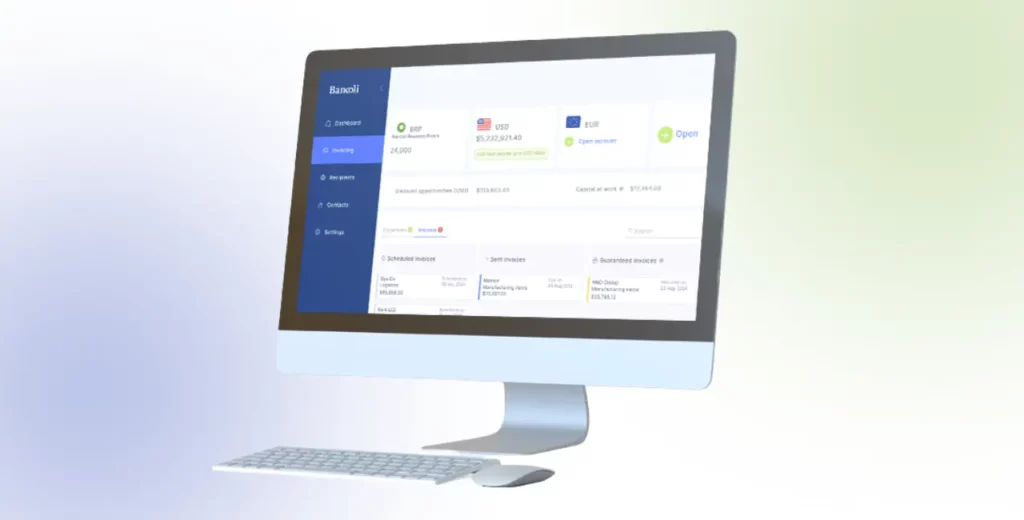
Cash flow acceleration distinguishes this platform from alternatives. On paid plans, Eric, Bancoli’s AI Assistant, analyzes invoice patterns and suggests early payment discount terms. When a buyer accepts the discount and pays early, the invoice becomes “Guaranteed,” providing payment certainty, with pre-maturity fund access on Enterprise plans. This mechanism can help reduce DSO without factoring fees or external financing.
Bancoli sends local payouts from your USD account, which clients fund by ACH, RTP, US domestic wire or stablecoins. You can use those funds to finance operations or pay suppliers abroad with free FX in 25+ currencies.
For the full fee schedule, visit Bancoli’s pricing page.
How invoice payment processing platforms compare
| Feature | Stripe Invoicing | QuickBooks Payments | Bill.com | FreshBooks | Bancoli Instant Checkout |
|---|---|---|---|---|---|
| Monthly cost | Pay per use | See QuickBooks pricing | From US$49/user/mo | From US$23/mo | From US$29/mo |
| Invoice fee | 0.4-0.5% per invoice | Included | Included | Included | Included |
| Card processing | 2.9% + US$0.30 | 2.99% | 2.9% | 2.9% + US$0.30 | Not offered (B2B non-card focus) |
| ACH fee | 0.8% (cap US$5) | 1% | See Bill.com pricing | 1% (caps on Select plans) | ACH debit on paid plans |
| Wire transfers | Accepts wires via bank transfers (US) | Not supported | Limited | Not supported | Not offered in Instant Checkout |
| Stablecoin payments | Yes (US, settles in USD) | No | No | No | Not offered in Instant Checkout |
| Bank debits in one invoice | ACH debit | ACH bank transfer | ACH ePayment | ACH bank transfer (US) | ACH debit and Bancoli debit, on paid plans |
| Guaranteed Invoices | No | No | No | No | Yes (pre-maturity access on Enterprise) |
| FX conversion | 1.5% international surcharge | 1% international fee | Not specified | Via Stripe rates | Free FX in 25+ currencies |
How embedded checkout works
Bancoli’s Instant Checkout follows a four-step invoice payment processing flow that eliminates friction between invoice creation and payment settlement.
Step 1: Create and configure your invoice
You create an invoice using Bancoli’s invoicing tool with standard line items, amounts, and due dates. On paid plans, Instant Checkout accepts ACH debit and Bancoli debit.
Eric, Bancoli’s AI Assistant, can suggest terms for an early payment discount. For instance, a 2% discount for payment within 10 days on net-30 terms. You can also configure late payment penalties if needed.
Step 2: Send the invoice with embedded payment options
Your client receives a professional invoice with all selected payment methods embedded directly in the document. Consequently, they see payment options, any early discount opportunities, and clear payment instructions without needing to contact your team separately.
Step 3: Client selects and pays
Your client pays by ACH debit or Bancoli debit without leaving the invoice. If they pay within the early discount window, the system automatically applies the discount percentage. Therefore, no manual calculation or adjustment is required.
Step 4: Automatic settlement and fund access
Payments deposit directly into your Smart USD Wallet. Early payments create “Guaranteed Invoices,” allowing Enterprise accounts to access funds before the original maturity date. As a result, your cash conversion cycle can shorten.

Strategic cash flow acceleration through invoice optimization
Instant Checkout integrates with Bancoli’s cash flow management tools to transform invoice payment processing from a passive billing activity into an active working capital optimization strategy.
Early payment discounts create mutual benefit
Early payment discounts incentivize clients to pay before the due date. In practice, this strategy reduces Days Sales Outstanding without manual collection efforts or aggressive follow-up.
A 2% discount for payment within 10 days on net-30 terms represents an annualized return of about 37% for your client. This creates a strong financial incentive for immediate remittance. Eric analyzes your invoice patterns and suggests optimal discount terms automatically.
You configure discount terms when creating the invoice. The system automatically applies the discount if your client pays within the window. As a result, errors are eliminated and discount application remains consistent.
Guaranteed Invoices replace expensive factoring
When your client accepts an early payment discount and remits funds, the invoice becomes “Guaranteed.” This designation provides several strategic benefits:
- Payment certainty: Funds are committed to that specific invoice. Payment uncertainty disappears, and you know exactly when cash will be available.
- Pre-maturity access: On Enterprise plans, you can access Guaranteed Invoice funds before the original due date.
- Alternative to factoring: Guaranteed Invoices provide predictable payment dates without the complexity, high fees, or debt associated with selling receivables. This approach avoids the 3-5% factoring fees common in traditional invoice financing.
In turn, this mechanism offers institutional-grade assurance for cash flow projections. Finance teams can plan supplier payments, payroll, and operational expenses with greater confidence.
Late payment penalties deter delayed remittance
You can also configure late payment penalties when creating invoices. These penalties compound at a specified rate (such as 3% every 15 days) after the due date passes.
Furthermore, many businesses find that simply including penalty terms improves on-time payment rates even when penalties are rarely enforced. The financial incentive structure encourages prompt payment behavior and compensates for the opportunity cost of capital tied up in overdue receivables.
The 5-minute invoice payment processing audit
Most businesses remain unaware of their actual DSO costs and payment processing inefficiencies. Therefore, this diagnostic reveals your optimization opportunities in six steps.
Step-by-step assessment
- Pull your accounts receivable aging report for the last three months
- Calculate your average DSO by dividing total outstanding receivables by average daily revenue
- Identify which payment rails your invoices currently offer (card only, ACH only, wire only, or multiple)
- Count how many separate portals or processors your team checks daily for payment confirmations
- Estimate the monthly hours spent on manual reconciliation across fragmented systems
- Calculate the working capital trapped in outstanding invoices (monthly revenue × DSO ÷ 30)
What your numbers reveal
Typically, businesses discover significant improvement opportunities:
- DSO under 30 days: Your invoice payment processing is efficient. Monitor quarterly.
- DSO 30-45 days: Room for improvement. Embedded checkout and early discounts can help reduce it.
- DSO 45-60 days: Typical B2B range. Immediate savings available by adding payment rail flexibility and discount incentives.
- DSO over 60 days: Significant working capital is trapped. Prioritize cash flow acceleration tools.
As a result, this audit shifts the conversation from “when will clients pay” to “how can we accelerate payment through reduced friction and strategic incentives.”

Choosing the right invoice payment processing platform
The best platform depends on your specific invoice payment processing needs. Consequently, matching your transaction profile to the right feature set prevents overpaying for unnecessary capabilities or missing critical ones.
When traditional platforms work well
Stripe Invoicing works best for businesses that primarily accept card payments, need developer API access, and operate in e-commerce or SaaS subscription models.
QuickBooks Payments serves businesses already using QuickBooks for accounting that need seamless payment-to-ledger integration for domestic card and ACH transactions.
Bill.com excels at accounts payable automation for mid-market companies managing high-volume vendor payments with approval workflows.
FreshBooks fits freelancers and small service businesses that need simple, attractive invoice templates with basic card payment acceptance.
When you need embedded invoice checkout
If your business invoices clients internationally, processes transactions above US$5,000 regularly, or needs to accelerate cash flow beyond what payment reminders provide, embedded invoice checkout delivers measurably higher returns.
Bancoli’s Instant Checkout addresses these needs specifically. On paid plans, Instant Checkout accepts ACH debit and Bancoli debit. Together with AI-suggested early discounts and Guaranteed Invoices, it targets the cash flow acceleration gap that traditional platforms do not address.
Conclusion
Invoice payment processing no longer requires choosing between payment flexibility, cost efficiency, and cash flow acceleration. Embedded checkout removes the friction that delays B2B payments.
Traditional platforms like Stripe, QuickBooks, Bill.com, and FreshBooks handle card and ACH invoice payments effectively. However, they do not address the broader cash flow challenge: reducing DSO through payment rail diversity, strategic early discounts, and guaranteed payment mechanics.
Three steps to optimize your invoice payment processing:
- Audit your current DSO and payment rail coverage using the 5-minute diagnostic above
- Implement embedded invoice payments through a platform like Bancoli’s Instant Checkout to reduce payment friction
- Activate early payment discounts and Guaranteed Invoices to accelerate cash flow
Ultimately, the combination of embedded checkout and cash flow acceleration tools transforms billing from a passive administrative task into a strategic working capital optimization function.
Frequently asked questions
What payment rails does Instant Checkout support?
On paid plans, Instant Checkout accepts ACH debit and Bancoli debit. You select which options to offer per invoice based on transaction characteristics and client preferences. Importantly, Bancoli does not process credit or debit card payments. The platform focuses specifically on B2B non-card payment rails that eliminate the 2-3% card processing fees common on large transactions.
How does embedded checkout reduce Days Sales Outstanding?
Embedded checkout reduces DSO through three mechanisms. First, letting buyers pay inside the invoice eliminates the friction that delays client payment. Second, early payment discounts incentivize faster remittance by offering buyers a financial return for prompt payment. Third, Guaranteed Invoices provide predictable payment timing, with pre-maturity fund access on Enterprise plans. As a result, these features can help reduce DSO compared to traditional invoice payment processing.
Can I invoice international clients and pay out with free FX?
Clients pay your invoices into your named USD account details, and on paid plans, Instant Checkout accepts ACH debit and Bancoli debit. When you pay suppliers abroad, Bancoli offers free FX in 25+ currencies and local payouts. For current plan details, visit Bancoli’s pricing page.
What is a Guaranteed Invoice and how does it improve cash flow?
When your client accepts an early payment discount and remits funds, the invoice becomes “Guaranteed.” Essentially, funds are committed to that specific invoice, eliminating payment uncertainty. On Enterprise plans, you can access Guaranteed Invoice funds before the original maturity date, which accelerates your cash conversion cycle. This mechanism provides an alternative to traditional invoice factoring, which typically charges 3-5% in fees and involves selling receivables to a third party.
How does Stripe Invoicing compare to Bancoli?
Stripe Invoicing excels at card-based payment acceptance with developer-friendly APIs, supporting 135+ currencies and 25+ languages. Stripe charges 0.4-0.5% per paid invoice plus payment processing fees (2.9% + US$0.30 for cards). In contrast, Bancoli does not use card processing. On paid plans, Instant Checkout accepts ACH debit and Bancoli debit. On paid plans, Bancoli also provides AI-suggested early discounts and Guaranteed Invoices for cash flow acceleration, features Stripe does not offer. The choice depends on whether your priority is card payment acceptance (Stripe) or B2B bank payments with working capital optimization (Bancoli).
Do I need multiple payment processors for different rail types?
No. On paid plans, Instant Checkout accepts ACH debit and Bancoli debit. You do not need a separate relationship with an ACH provider, and payments land in your Smart USD Wallet. In turn, this consolidation reduces reconciliation time and eliminates the need to check multiple portals daily.
How quickly can a business reduce DSO with early payment discounts?
Results are typically visible within the first billing cycle. Once you configure early payment discount terms on your invoices, clients can begin taking advantage of discounts immediately. Account approval times vary by documentation and jurisdiction. The first invoice with embedded Instant Checkout can be sent immediately after activation.